

Hiking with your dog can't be improvised!
Do you love hiking and would like to share this activity with your dog? You've come to the right place! Where can you hike with your dog? What should you bring for a hike with your dog? Here are the essential tips for choosing the right route, packing your bag, and avoiding mishaps on the trails.
Table of contents
Hiking with your dog is a fantastic activity to share with your everyday companion. It's an outdoor activity suitable for everyone and it's free!
Personally, I'm a big fan of hiking. It's the best way to discover a region, in my opinion. Along the sea, from peaks to valleys in the mountains, through the sunken lanes of the countryside… hiking allows you to discover magical landscapes.
We take our time, we are in nature, we are free! Whether for a day trip or a longer journey, going hiking with your dog requires preparation.
Route, equipment, advice… let's review everything together before you set off with your dog!
⏱️ Key points to remember in 1 minute
Yes, hiking with your dog is a great idea… if the outing is suitable for you and your dog. Before setting off, check dog access, the difficulty level, the weather forecast, water sources, and any potentially hazardous sections. Also, be sure to bring supplies to hydrate, re-leash, and treat your dog in case of an emergency.
Hiking with your dog: a good idea?
On paper, going hiking with your dog often seems like an excellent idea. You get fresh air, share a real moment together, discover new landscapes, and come back with a happy, well-exercised… and usually very tired dog!
But hiking with your dog doesn't mean heading out on just any trail, any day, with any dog. A hike can be a wonderful experience for the two of you, but it can also quickly become a nightmare if it's not suitable.
Not all dogs have the same abilities. A young, growing dog, an older dog, an overweight dog, a sick dog, a brachycephalic dog, or a dog unaccustomed to long walks will not experience hiking in the same way as a sporty, trained dog. The same applies to temperament: a very sensitive dog, highly reactive to other dogs, humans, bicycles, or livestock, will need a calmer, safer route.
The weather also completely changes the game. A pleasant hike in the spring can become dangerous in the middle of summer if the sun is blazing, if the ground burns their paws, or if the route lacks shade and water sources. Conversely, in the mountains, the cold, wind, snow, snow patches, or slippery sections can complicate the outing, even for a motivated dog.
In short, yes, hiking with your dog is a great idea… provided you go with a little preparation. Before lacing up your hiking boots, simply ask yourself the right questions: Is my dog fit? Is the weather suitable? Will the terrain be appropriate for him? Do I have what I need to give him water, to tie him up, to treat him in case of minor injuries, and to shorten the hike if necessary?
This is exactly where it all comes together: a successful hike with your dog begins even before you set off, when you choose the right route.
✅ It's a good idea if…
Your dog enjoys walking, recovers well, tolerates the planned terrain and remains attentive when it is necessary to be put back on the leash or slow down.
⚠️ Avoid if…
Your dog is young, senior, poorly trained, brachycephalic, sick, sensitive to heat, in pain, or easily stressed by encounters. And if he hates it: especially if you are not able to carry him when needed.
If your dog is not athletic, give up the idea of a hike with him. He would suffer too much. Once gone, you will have to assume and insure because if your dog is too exhausted to finish the hike: you will have to carry him. Take that into account!
Also worth noting: small dogs will have more difficulty climbing obstacles, and dogs with short muzzles will quickly experience breathing problems, for example. But there are no hard and fast rules: I've seen French bulldogs in the mountains having a blast. It depends on each individual dog.
My first reaction with Musher
I always prefer a short, enjoyable hike, with breaks and a lively group, to a long, arduous outing where everyone ends up exhausted. And now that she's over 10, I'm adjusting the pace and duration of our outings.
Choosing the right route: questions to ask yourself
The right route isn't necessarily the most well-known, the longest, or the one with the most Instagram-worthy view. The right route is the one that suits your dog, your combined fitness level, and the day's conditions.
So before choosing a hike just because the photo is beautiful, look at the terrain with your dog's eyes: distance, elevation gain, heat, shade, water, narrow passages, stairs, bridges, herds, protected areas… It is often these details that transform a beautiful outing into a real ordeal.
Check that dogs are allowed on the entire course, not just at the start.
A short loop can be difficult if it is very steep, rocky or without shade.
A water source or a cool area can make all the difference, especially in summer.
💁 Important to know
Dogs are prohibited, even on leashes, in some national parks, nature reserves, and sometimes regional parks, in order to avoid disturbing the wildlife. Some mountain huts and guesthouses also refuse animals.
It is therefore essential to gather information before setting out. Violating a ban can result in a fine, and more importantly, it can endanger wildlife, livestock, or site managers.
For more information on the different mountain ranges that allow dogs , read the article "Where to hike with your dog ." Alps, Pyrenees, Massif Central, Jura… you'll find plenty of information to help you choose your route.
Start by looking at the distance and elevation gain. If your dog isn't used to hiking, it's best to plan a short, easy outing rather than a long, ambitious loop. A dog can be very motivated at the start, running everywhere, sniffing all the scents, taking the lead… then suddenly getting tired halfway through. And unlike us, they can't always clearly tell you when they've gone too far.
Also consider the type of terrain. A soft path in the forest, a wide track, or a trail along the water will often be more comfortable than a very rocky, exposed route or one with technical sections. Scree slopes, boulder fields, footbridges, ladders, ridges, drops, or long stretches of tarmac can be challenging, even dangerous, depending on your dog.
Shade and water are two essential criteria. In summer, opt for early morning starts, forest trails, routes with streams, lakes, or accessible bodies of water, and avoid hikes in direct sunlight during the hottest hours. However, be aware that water doesn't always mean safe swimming. During periods of intense heat, also check for the possible presence of cyanobacteria in certain lakes or rivers.
Before setting off, also check that dogs are allowed on the route. Some natural areas, reserves, national parks, or protected zones prohibit dogs, even on a leash. Others allow them under certain conditions. In the mountains, the presence of livestock and livestock guardian dogs may also require you to adapt your route or your behavior.
Finally, consider the number of people on the trail. If your dog is comfortable around people, children, bicycles, other dogs, and horses, a busy trail might not be a problem. If not, choose quieter routes, less busy times of day, or loops where you can easily keep your distance.
The best approach: always allow for some flexibility. A shorter loop, a possible shortcut, a potential U-turn, a break in the shade, a water source along the way… With a dog, the goal isn't to "complete the loop at all costs." Adapt the outing to its pace, its condition that day, and the enjoyment you both have together.
My experience with Musher
Musher has a terrible fear of heights. If she has to jump between two rocks with a drop of more than a meter, I have to reassure her considerably before she'll even decide to jump. I've already had to turn back because I didn't have anything to carry her safely, or take a detour of several kilometers to avoid a particularly dangerous area. Since then, I've equipped myself with a special harness so I can carry her, even though my back doesn't really appreciate the effort…
Musher is a water dog. She loves hikes but I always try to choose the course according to the water criterion. With each swim, she recharges her batteries. It is surprising ! A few swims and here she is again in front of me more motivated than ever. Each of our hikes crosses or runs along a river!
 Musher's seasonal advice

Hike with suitable equipment
Three options for hiking with your dog:
It moves freely alongside you, which assumes that recall is perfectly mastered.
Your dog helps you by being connected to you with suitable traction equipment.
Perfect if you're going away for a long time and your dog can carry a small part of its belongings.
To go hiking with your dog safely, you need a few essentials:
- water to avoid any dehydration (this is often what weighs very heavy)
- his collar with a medallion allowing him to be identified
- his leash so you can reattach him in case of danger, or when crossing certain protected areas, or if you encounter a flock of sheep and especially a Pyrenean Mountain Dog (here our survival guide for sheepdogs)
- another first aid kit for leg cuts, stings, sores of all kinds with of course the list of veterinarians on the course or nearby
- his passport
- another travel bowl for refueling breaks
- some special dog energy candies in case of cravings. Dogs also suffer from it, and yes! The greedy musher that she is never forgets the snack breaks! She eats dried salmon, it stinks but it's high in calories!
- Dog booties are essential in case of paw injuries. If a paw pad is damaged, your dog will limp and the hike will quickly turn into an ordeal.
- A mat? I always carry a microfiber towel with me that I use as a mat. It doesn't take up much space in my backpack, but when we stop, it gives her a designated area, like her mat at home. She really appreciates it. Without this "mat," she won't sit down or rest... Decathlon has released a great one portable dog mat.
- are pack bag for dog in which my dog carries his things
Your dog can carry its equipment on its own back… BUT be aware that it cannot carry more than 10% of its weight.
WARNING: It's also impossible to put 10% of your dog's weight on your back without a period of acclimatization or training. Before setting off, you'll need to test the carrier on several walks, gradually increasing the weight and length. This is only possible with a dog in perfect health, without back, joint, or arthritis problems. Remember, your dog is like you: if you have back pain and are made to carry 10% of your weight for several hours, what will the result be?
If you have the slightest doubt about his abilities: go to the veterinarian for a check-up!
A little tip: remember to pack what you put in the bat bag, in case of rain or if your dog jumps into the water before you have had time to remove his harness: this will avoid making the porridge of croquettes for example…
If you'd like to try bivouacking, I recommend reading the article dedicated to this activity: Bivouacking with your dog . I do it from time to time with Musher, so I've shared my experience and tips with you.
For a short outing, there's no need to carry your entire house on your back. But as soon as the hike gets longer, the terrain becomes more technical, or you want to try cani-hiking, the choice of equipment becomes really important.
I have actually prepared a much more comprehensive guide to help you choose the right equipment depending on your activity: walking harness, pulling harness, elastic leash, saddlebag, first aid kit, app to find routes… You can read it here: the ultimate guide to hiking with your dog.
The essential selection for a successful hike
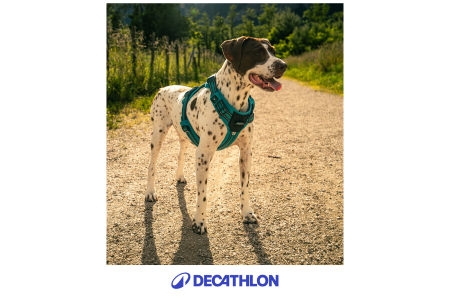
The Outdoor 500 walking harness
The simple and comfortable choice for walks, leisurely hikes and everyday outings.
From 27,99 €
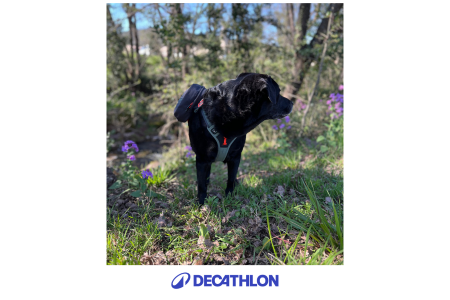
The 2-in-1 saddlebag harness
The perfect companion if you're going on a longer hike where your dog is carrying their belongings. With its removable pouches, it easily transforms into a simple hiking harness.
From 54,99 €
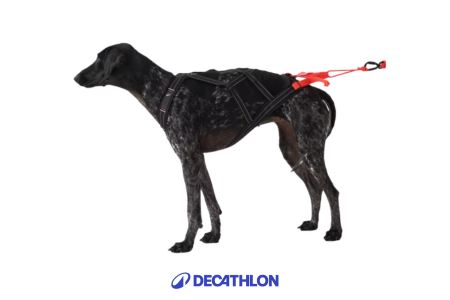
The x-back traction harness
If your dog naturally pulls or if you want to try cani-hiking, you need to switch to suitable equipment: a pulling harness, an elastic leash and a harness for you.
From 34,99 €
With Musher, we tested all the new dog sports accessories from Decathlon and here are our feedback, what we liked or what we would have liked to be different 👉 Musher tested the new sports accessories from Decathlon for you.
The dangers of hiking
To hike safely, there are several points on which you must be vigilant. Nothing too bad, just common sense points that I prefer to repeat here out of conscience.
You are responsible for your dog and its behavior. Do not let it roam freely or approach every hiker or animal it encounters. Some mountain cows do not appreciate a dog sniffing their calves too closely. A blow from a horn would be disastrous.
Your dog must absolutely obey the recall command if you want to let it off-leash. Some dogs have a hunting instinct, others are prone to running away. Adapt to your dog and keep it on a leash near a marmot camp, a herd of livestock, or a sensitive area.
Keep him cool and offer him a bowl of water very regularly. You can also spray him with water to prevent heatstroke . In the mountains, the sun is strong, and dogs with light skin can get sunburned. It's best to leave early and avoid walking in the direct sunlight.
Musher wears a cooling vest that I wet very regularly.
Take breaks to play with him or simply to rest. If you need it, he does too. There's no point in rushing, you have to… you know the rest 🙂 Musher especially loves swimming and nap breaks against me!
Check the condition of his paws regularly! As for you in your shoes, it can heat up for his paws! If you fear blisters, he also fears leg injuries. This is where the boots will be very useful in the event of a problem in slightly hilly areas. If your dog can no longer put his paw down because you have nothing to relieve him, it's back home sooner than expected and the holidays are over! A wound under the legs requires a few days of mandatory rest for rapid healing...
The mountain can be dangerous. If your dog runs in all directions, without paying attention to where he puts his paws and his nose, he may fall into a ravine, come across a nasty viper who will not hesitate to show him who is the boss or a patou who risks to become very naughty if your dog is going to play in the middle of his herd. If he is crazy you will have to be vigilant for him!
Does your dog fit in your backpack? In case of an emergency, have you thought of a way to transport your dog? If your dog can no longer put weight on its paw and you have nothing to relieve its pain, it will be back home sooner than expected.
You might come across snow patches, those piles of snow that are still there even in summer. Musher loves sliding in the snow. Be careful that your dog doesn't ingest it: he could get sick. Musher was sick for 48 hours after eating snow… be careful!
Also worth reading to prepare for your next hike
Now that you have the right reflexes to prepare for a hike with your dog, all that's left is to choose your next playground! On EmmèneTonChien.com, we also share ideas for tried-and-tested hikes, dog-friendly nature destinations, and routes to explore with your dog, in France and even a little further afield.
Here are some articles to inspire you before planning your next outing:
- Top 10 hikes to do in the Cévennes with your dog
- Top 10 hikes: Southern Ardèche with your dog
- Haute-Savoie in summer with your dog: between hikes, lakes and visits
- Cotentin Bay: hiking, beaches... to enjoy with your dog
- Hiking with your dog in the Jura Mountains: 5 hikes not to be missed
- The most beautiful hikes in the Manche region with your dog
- Vosges: lakes and hikes with a dog
- Hiking with your dog around the Auvergne Volcanoes: 5 dog-friendly hikes
- Hiking with your dog along the Lot and Dordogne rivers: 5 walks by the water
- Where to hike with your dog? Tips and information by destination
6 Reviews
Leave a comment Cancel reply
You must be logged in to post a comment.
Leave a comment Cancel reply
You must be logged in to post a comment.



Super nice to share your adventures with your dog
Very interesting site that meets my expectations regarding sharing hikes with my dog. I will still have to wait: Voyou must grow up before attempting the adventure!
Indeed, it's best to protect his joints while he's growing! Then, get ready for some wild, woof-tastic adventures! In the meantime, here's a guide to traveling with a puppy , because there are a few things you should know 😉
Thanks for the advice, I will take it into account. Are there any walking groups with our dogs?
Yes of course, there are many Facebook groups to meet and go for walks with other dog owners ;)
Hello, I just discovered your site, I can't wait to read more! Thank you for sharing your experience with us!