
Traveling with a senior dog: a guide to going on holiday together
How can you adapt your vacation to your senior dog? What are the important considerations when choosing your rental and what equipment should you bring? What should you look out for to ensure your dog enjoys the trip as much as you do? Find valuable advice for your old pooch in this article.


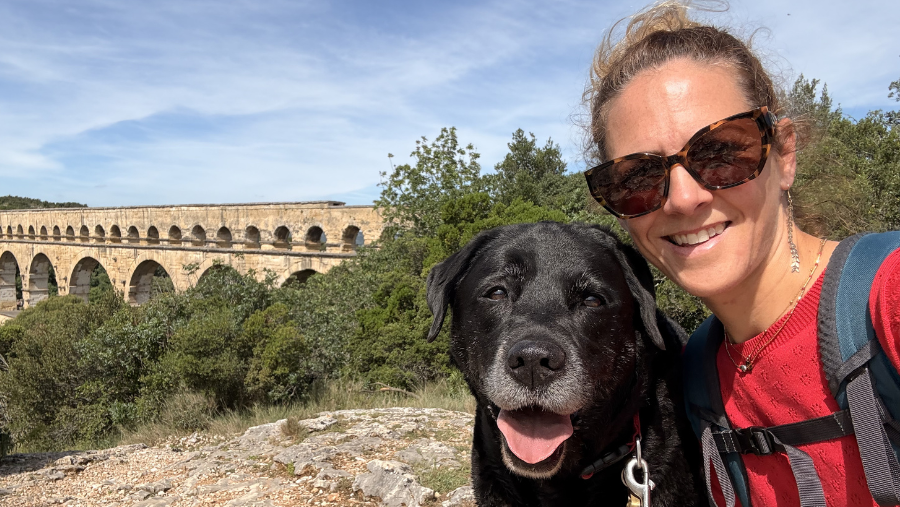
Musher is 12 years old. She still loves going on vacation, discovering new paths, swimming, and being part of every adventure. But naturally, our vacations aren't quite the same as they were a few years ago.
These days, I pay more attention to the elevation gain before choosing a hike. I'm careful about stairs when booking accommodation. A ramp helps her get into the car. And this summer, I really realized how much a single year can change a senior dog's abilities : Musher, who tolerated the heat quite well the previous summer, was much more sensitive this year.
Having an aging dog doesn't necessarily mean you can stop traveling with it. However, sometimes you need to learn to travel differently.
Choosing accommodation, walking schedule, warmth, recovery, ramp, stroller, bike trailer, GPS, life jacket… Here is all my advice for continuing to go on holiday with your senior dog, while respecting its new capabilities.
Summary
Senior dog: adapt your vacation
There is no specific age at which all dogs become seniors. Aging depends on factors such as their size, breed, health, and simply each individual dog.
Two 12-year-old dogs can therefore have very different abilities.
And if, like me, you sometimes find it hard to believe your dog is getting older, you can use the dog age calculator in human years . It takes into account the dog's size, because a small dog and a large dog don't age at the same rate.
This can sometimes be a bit of a blow to morale… but it also helps us better understand why our companion no longer has quite the same abilities as a few years ago!
For my part, I hadn't realized how much Musher had aged until this summer, but I had to face the facts when I stuck 12 candles on his birthday banana. I admit it was a shock… I dread this parade of years…
Regularly review what he can still do
The trap with our old companions is continuing to see them as they were a year or two ago. Before planning your vacation, ask yourself a few very specific questions:
- How long can he walk today without showing any signs of fatigue?
- Does he recover easily after a walk?
- Is it particularly stiff the day after a long day?
- Does he have more trouble getting up after a nap?
- Does he hesitate in front of the stairs?
- Is he still able to get into the car by himself?
- Can he still hear when we call him?
- Has his eyesight deteriorated?
- Does he sometimes get disoriented?
- Does it still tolerate the heat as well?
- Does he need to go outside more frequently to relieve himself?
Depending on your answers, you'll have a much better idea of whether you'll need to adapt your vacation plans . The goal isn't to stop everything just because your dog is getting older, but to identify what's becoming more difficult for him so that the whole family can continue to enjoy the vacation together without putting him in a difficult position.
❤️🩹 Remember that aging is not a disease . It's normal to observe a decline in your dog's abilities as they get older. The main question to ask yourself is: is he suffering?
If you notice a significant or recent change that worries you, don't hesitate to talk to your veterinarian. Difficulty walking, the onset of incontinence, a sharp increase in thirst, or changes in behavior… My advice: film your dog when it shows these signs that seem abnormal to you, as it's unlikely to repeat them at the vet's. This will allow the professional to better interpret the potential symptoms.
Don't rely on what he did last year.
This is probably one of the things that struck me most this summer with Musher. I was still, subconsciously, basing my opinion on the dog from the previous summer. Yet, at 12 years old, a year counts.
This summer, I noticed that Musher tired much more quickly when it was hot. I had to change the timing of our outings, shorten some walks, and accept that what she tolerated very well a year ago was no longer necessarily suitable today.
And I think that's the hardest part: our dogs don't send us a little message to let us know that their boundaries have changed! It's up to us to observe them and adapt.
Learn above all how to change the program
This is probably the biggest adjustment when travelling with an aging dog.
Before, you might have looked at a hike and simply wondered, "Are dogs allowed?" With a senior dog, a second question becomes essential: "Is this activity still suitable for my dog?" And sometimes, the answer will be no.
My advice :
- Don't hesitate to warm up your dog before walks or hikes, especially if he has arthritis, which is less painful when the muscles are warm.
- Give him massages when he wakes up or after exercise: I've noticed that it really helps Musher wake up, even though I'm not a professional masseuse;
- Opt for several short walks, rather than one long walk;
- Don't hesitate to turn back before the summit;
- Visit only part of a site;
- Plan for more breaks.
Changing the plans doesn't mean giving up on vacation. Having a 5-year-old daughter, I've already experienced this adjustment. We had to change our vacation habits when she arrived. Now, we adapt them so that Musher can continue to come with us as long as possible, even if it's sometimes frustrating.
 Musher's seasonal advice

Choosing accommodation suitable for your senior dog
When travelling with your dog, choosing accommodation that is truly suitable for them is already essential. And with a senior dog, it becomes even more important.
This is precisely the advantage of QUALIDOG-certified accommodations : beyond simply "dogs welcome," you have access to a wealth of concrete information about the conditions under which your dog is accommodated, the available facilities, any restrictions, and the services offered. A true indicator of quality for planning your holiday with greater peace of mind.
On EmmèneTonChien.com, you can directly search for your dog-friendly accommodation and filter for establishments with the QUALIDOG label.
💡 My tip : choose a property where at least the ground floor meets accessibility standards for people with reduced mobility. This ensures there are no steps to navigate between the outside and inside, nor between the rooms on the ground floor.

EmmèneTonChien.com is not a booking platform: we connect you directly with accommodation providers . When traveling with a senior dog, this is a real advantage. You can contact them before booking, explain your dog's specific needs , and discuss the small details that can make all the difference.
Before booking, be sure to check these points:
- Stairs and accessibility If possible, opt for a ground-floor accommodation with few steps between the parking area, the accommodation, and the garden. For those with arthritis or fragile hips, this can significantly impact the comfort of their stay.
- The grounds Smooth tiles or slippery parquet flooring can pose a problem for an older dog. A few non-slip mats can be enough to secure walkways.
- Access to the garden : an easily accessible outdoor area is very practical if your dog needs to go out more often or starts to have some small accidents.
- The coolness of the accommodation In summer, see if it's possible to keep a room cool with shutters, shade, or air conditioning. A senior dog can become much more sensitive to heat.
- Heating efficiency Senior dogs need to be kept warm, so make sure at least one room stays warm and draft-free.
Because accommodation perfectly suited to a dog won't necessarily be the same for every dog. And as your dog gets older, it's best to make sure beforehand that the accommodation will truly meet its needs and comfort.
What equipment do I need to travel with a senior dog?
Some accessories may seem completely unnecessary when your dog is young. Then comes the day when they simply allow you to continue going out with him.
Sleeping bag, ramp, GPS, stroller, backpack… There is now a huge amount of equipment available and it is not always easy to know what to choose.
Before buying, I recommend you take a look at all our comparisons of dog equipment and accessories . At Musher, we've been testing equipment for years and we primarily try to help you determine which equipment to choose based on your dog, your training methods, and your budget.
In any case, I recommend bringing his basket, blanket, one or two of his toys, and his usual walking gear. This will help him feel comfortable in an unfamiliar environment.
A bed suitable for his age
It's tempting to offer your senior dog a super soft bed, thinking he'll love snuggling up in that little cloud. In reality, it's not the best option for his joints.
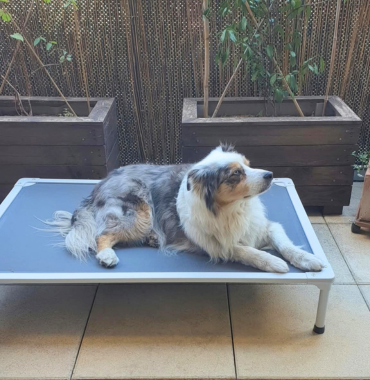
Opt instead for an orthopedic mattress or a camp bed . Both types of bedding offer firmness that prevents strain on the joints, especially when your dog wakes up cold – the time when arthritis is most painful. They also insulate your dog from the cold, dampness, and, in the case of a camp bed, from the heat of the ground, providing remarkable comfort.
Musher loves the raised edges of his bed for resting his head. Consider your dog's preferences when choosing their bed. Important: if there's a raised edge, make sure there's still a wide opening, without any edge to climb over, to make it easy for your dog to get in and out.
💡 My tip : For dogs with incontinence, place an absorbent mat on your dog's bed. You can even have two to alternate while one is in the wash. There are also dog diapers available to keep your dog dry and your vacation rental clean. Be sure to get your dog used to them before your stay so they aren't unsettled.
A ramp to get into the car
To travel, you first need to be able to get into the car. And that's a very real issue for us right now. Musher still jumps into the trunk by herself. But I can see that it takes her a lot more effort than before, and I'm especially worried that one day she'll land badly and hurt herself. So this year, we got some equipment: Madame Musher now has her own ramp!
A dog ramp helps prevent repeated jumping up and down. Be careful, a ramp that is too short can create a very steep incline and become difficult to use.
And a little tip from experience: don't take out the ramp for the first time when you go on vacation hoping that your dog will immediately understand the concept! Get him used to it gently beforehand, at his own pace.
A harness with a mobility aid handle can also be useful to accompany your dog when it needs to go over some steps, get into the car or simply stand up.
Also consider the journey itself. On a long trip, plan more breaks than usual so your dog can walk for a few minutes, drink, and relieve itself. And if it's on medication, keep it easily accessible and bring enough for the entire trip.
The dog stroller or the dog backpack
Yes, the dog stroller might seem amusing. But honestly, the older Musher gets, the less these kinds of accessories make me smile and the more I understand their appeal.
If your dog can no longer walk as long as before, a stroller for large dogs, or a suitable backpack for small dogs, can allow you to continue taking him with you without requiring too much effort from him.
The principle is simple: your dog walks as long as it remains comfortable for him, then he rests when he gets tired.
City visit, market, seaside walk, easy hike… These facilities mainly allow you to continue to share the outing together , even if your dog can no longer do everything on its four legs.
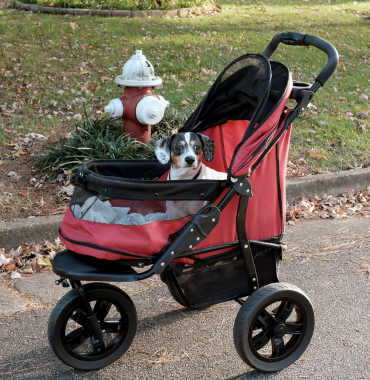
To choose a suitable model for your dog, you can also consult our comparison of the best dog backpacks 🎒. Our comparison of dog bike trailers also recommends several 2-in-1 trailers that can be transformed into dog strollers, so feel free to take a look!
GPS: a real safety measure if your dog becomes deaf or disoriented
It's probably the accessory you think about the least when your dog starts getting older: a GPS tracker . Yet, it can become very useful. A dog with hearing loss can continue its walk peacefully without realizing you're calling it.
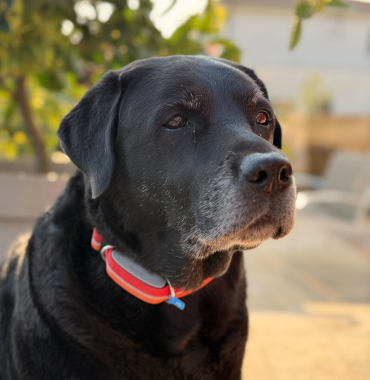
Some older dogs may also become more disoriented. This can be even more problematic on vacation, when they are in a completely unfamiliar environment. A GPS tracker attached to the collar or harness makes it easier to find your dog if needed.
If you are considering purchasing a GPS tracker, we have prepared a comparison of the best GPS trackers for dogs with the different criteria to consider before choosing.
However, be aware: GPS is an additional safety measure, not a substitute for a long line or leash.
If your dog becomes deaf, disoriented or responds much less well to recall, favor fenced areas and walks with a long leash.
Also remember to check that their ID and your phone number are up to date.
What activities can you do with a senior dog on vacation?
A senior dog is not necessarily a dog that should stop all activity, quite the contrary! As long as its health allows, continuing to move gently remains important.
The difference is that you will have to adapt the duration, intensity, equipment and recovery time.
And that's probably what I'm learning the most with Musher right now: not to stop experiencing things together, but to find a new way to experience them.
Hiking: Don't just look at the kilometers
With a senior dog, distance is just one indicator among others.
See also:
- the difference in elevation;
- the technicality of the terrain: walking on grass or on pebbles does not require the same effort;
- the presence of rocks or large steps;
- the available shade;
- the possibilities of turning back;
- water points;
- the predicted air temperature and humidity.
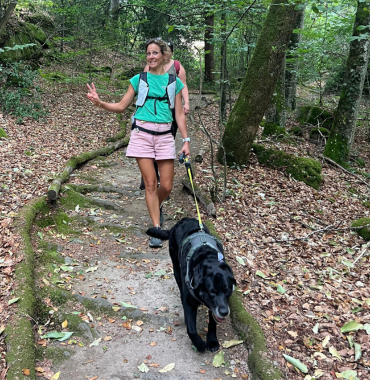
A 4-kilometer walk with a lot of elevation gain and rocks can be much more difficult than a 7-kilometer walk on a flat path.
Nowadays, when I choose a ride with Musher, I pay much more attention to the route profile than before . And I also try not to set an absolute goal: if she gets tired, we turn back. The summit will still be there another time.
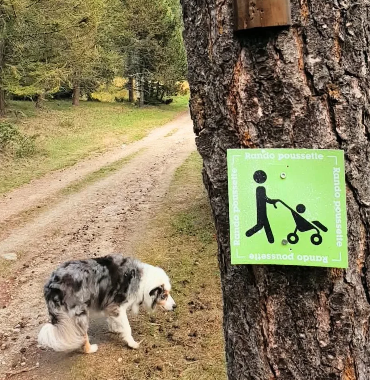
3 tips for finding routes suitable for senior dogs:
- Follow the DFCI, these drivable roads which serve to “cut off” the path of fires and facilitate the mobility of rescue services in the wilderness.
- Find some stroller hikesDid you know about this? I came across it at the Font Romeu resort in the Pyrenees, and I thought it was a brilliant idea. The slope is manageable and the ground is well laid out.
- Along the same lines, you can find rollerblading, suitable for both strollers and wheelchairs, practical for your dog to walk on the floor without hurting itself, or if you are walking it in a stroller.
Also, observe your dog after the activity. He may be so happy to follow you that he'll continue long after he should have stopped. The right question, therefore, isn't just, "Can he do this walk?" but also, "What condition will he be in this evening and tomorrow morning?"
If he's extremely stiff, has trouble getting up, or seems exhausted the next day, it might be because the effort was too much. With a senior dog, a successful hike no longer necessarily means reaching the summit. It mainly means returning home with a dog who enjoyed the day without pushing himself too hard.
Bicycle: consider using a trailer
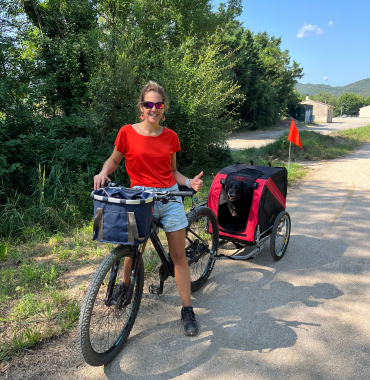
Your dog used to accompany you on your bike rides but no longer has the stamina? You don't necessarily have to give up this activity together. A dog bike trailer (or bike basket for small dogs) allows you to continue exploring a destination while letting your dog rest.
For example, he can walk a little during a break or at the beginning of the route and then rejoin his trailer to cover the rest of the stage.
Here again, not all models are created equal: dimensions, maximum load, stability, ventilation… If you want to equip yourself, check out our comparison of the best bike trailers and dog baskets.
Swimming: add a life jacket
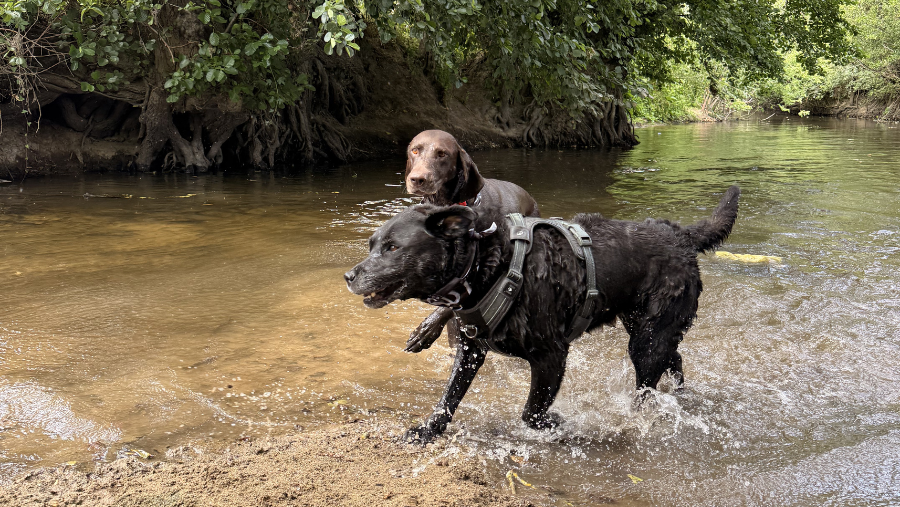
Your dog can still love water even if he has much less stamina than before. And Musher is one of those dogs for whom seeing water is still an excellent reason to forget, for a few minutes, that he's 12 years old!
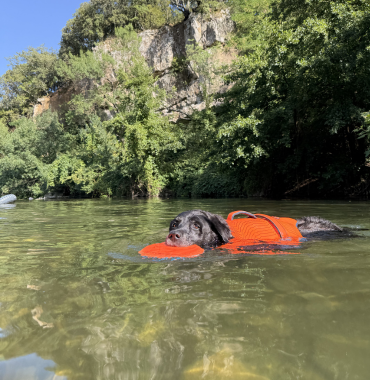
The problem is that her desire to play remains intact, while her physical abilities have diminished. Musher used to love jumping into the pool to catch her frisbee; now I forbid it because she suffers terribly with back pain for days afterward.
A dog life jacket provides buoyancy, allowing your dog to enjoy the benefits of swimming while avoiding the effort of staying afloat. Choose a model with a handle on the back: it can be invaluable for helping your dog get out of the water, onto a paddleboard, or into a boat.
With a senior dog, don't just consider swimming. Ask yourself: "How will he get into the water and, more importantly, how will he get out?" A steep bank or slippery rocks can become much more problematic, even a real danger!
To choose the right equipment according to the size and activity of your dog, you can consult our comparison of dog life jackets.
And above all, dry your dog thoroughly after swimming. Cold and damp conditions are definitely not good for a dog whose joints are already starting to become sensitive.
Make recovery a real part of the program
This is probably one of the most important things to remember when traveling with an older dog. You don't necessarily need to fill every day. A morning hike can easily be followed by a whole afternoon of sleeping. A long walk today can justify a much more relaxed schedule tomorrow.
And when temperatures rise, adapt your schedule even more: walks early in the morning or in the evening, water available at all times, breaks in the shade and cool accommodation in summer or warm accommodation in winter to recover.
With a senior dog, rest is not wasted time between activities. It is an integral part of the activity.
Points to be aware of when dealing with a senior dog
Enjoying a holiday with a senior dog also means being vigilant about anything that could injure him or make his day more difficult. Knowing these risks allows you to prevent problems rather than just treat them!
Okay, since I'm a chatterbox, I've included them in a fold-out format! That way, you can easily find and read the ones that are suitable for your dog and the season 😉
Several movements should be avoided in dogs that are not warmed up, but in a senior dog, I recommend that you no longer encourage him to perform them at all.
Anything involving rapid flexion and extension of muscles and joints becomes dangerous, as your dog weakens with age: he no longer has the same flexibility or resilience as before. These movements become painful and take longer to recover: it's best to prioritize gentle movements and warm-ups as much as possible!
Some habits to change to avoid injuries:
- chasing after a ball like a madman Going from a standstill to sprinting is hard on the body; it's better to throw the ball a shorter distance or hide it and ask him to find it – much more stimulating!
- to make sudden U-turns : during toy throwing or play sessions with friends;
- Jumping into the water from a promontory, especially if it is slippery, is dangerous. Musher paid the price a few months ago with a badly locked back, so since then it's forbidden!
- to hang from a toyEspecially with small dogs: do you ever lift your dog by the toy it is chewing? Its neck takes a beating, prefer to keep the toy at its level and avoid rapid changes of direction.
In general, good habits to keep in mind: warm up your dog before any exercise (even a short walk around the block!) and don't hesitate to give him massages . With some soft music playing in the background, it's a moment I love to share with Musher 🥰
My grandmother always told me that her superpower was predicting rain 😅 As soon as her knees started hurting, she knew the rain was coming. Thanks, arthritis!
Just like us, dogs are becoming increasingly sensitive to cold and damp . This can exacerbate arthritis pain , or simply make them more uncomfortable. And it's not just a minor detail : while Musher used to sleep on the tiled floor summer and winter in her younger years, today she always chooses the comfort of her bed when the floor gets chilly.
My tips for protecting your dog from moisture :
- place an absorbent mat in the trunk of the car
- Dry him thoroughly from head to tail after boating trips or rainy walks; don't hesitate to put a dog bathrobe on him to absorb the last drops.
- Equip your dog with a raincoat when it rains; this is the most effective way to prevent moisture from penetrating their fur. This is especially important in cold weather, as moisture intensifies the sensation of cold and therefore potential pain.
I can already hear you saying, “ A dog is a dog, it doesn't need clothes! ” We partly agree! Not all senior dogs need a raincoat, especially if their undercoat is in good condition and they are in excellent health. However, dogs have been domesticated for over 10,000 years; they have therefore lost much of their independence and some of their ability to cope with temperature variations. Some dogs genuinely need a raincoat or coat in winter ; it's not just a matter of comfort, but of well-being! So, it depends on the individual dog. 😉
You can compare different models of dog raincoats using our comparison tool : full suit or simple rain cape, the choice is yours!
To protect him from the cold , there are excellent dog coats available , which can be worn either throughout the entire outing or only during rest periods to prevent him from getting chilled. You can also cover his bed with a natural wool blanket, or insulate him from the cold with a camp bed , which I discuss in detail earlier in this article.
I'm bringing this up again because it's probably the biggest lesson Musher taught me this summer. We live in the south of France, and yet she's never been very sensitive to extreme heat, so until now we'd always managed the summer months quite easily. This year, I really saw a difference.
She tires more quickly. She seeks shade more readily. And some outings I would have done without much thought before now have to be postponed, shortened, or cancelled.
Cooling vests and accessories are available. If your dog is finding it increasingly difficult to tolerate the heat, check out our comparison of cooling accessories for dogs . I've been using a cooling vest for Musher for 12 years now.
Musher is 12 years old today and she still comes everywhere with us. And I really hope to make her a happy and healthy little old lady for as long as possible , while continuing to share as many experiences as possible with her. Of course, it saddens me to see her getting older. To see her nose turning white, the little white hairs appearing above her eyes, to realize that some things now require a little more effort from her.
But in the end, I'm getting older too! 😅 And I, too, am learning to listen to my body more, to change some habits, and to adapt. So I'm doing exactly the same thing for her.
Don't ask her to be the same musher she was five years ago. Nor should you give up everything she loves just because she's 12. But find the right rhythm, the right equipment, the right holidays, and the right compromises so she can continue to be part of the adventure for as long as she wants . Because ultimately, the most important thing has never been the number of kilometers covered. It's covering them together.
I hope this article has mainly inspired you to continue traveling with your senior dog, simply adapting your adventures to its pace.
Make the most of it. Continue to show him new places, to share walks, swims, naps in the sun, weekends and holidays with you… differently if necessary, but always together.
Our dogs are so precious. They age far too quickly, so while they still have the desire to be part of an adventure, let's try to allow them to enjoy it with us for as long as possible. ❤️
Comments
No comments yet. Have a question or experience to share? Start the discussion!