
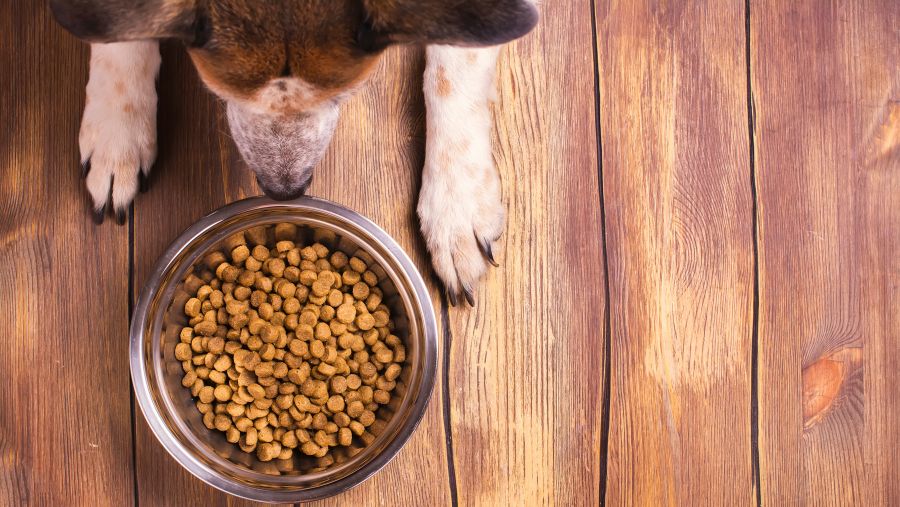
3 criteria to take into account when choosing the right kibble for your dog
In front of the dog food aisle, the choice can be difficult. So how do I choose the right package for my dog? I did not write this article myself but finding it interesting for the Wouafer's, I accepted its publication on the Mag'. I therefore leave the floor to the editor of the site Jardiland.com
Happy reading.
Table of contents
For your faithful companion to be in good health, it is important to provide him with quality and appropriate food. In particular, it is appropriate to take into consideration
its nutritional needs, which differ from one species to another and from one animal to another, its age and its tastes. These 3 criteria help you select the best kibble for your dog.
Target kibble according to your age and breed
On the market, there are 3 main categories of kibble: those for puppies, for adults and for senior dogs. And each of these 3 formulas presents foods of different composition and size. Puppy kibble is smaller because the teeth have not yet fully erupted. They are also richer to help with muscle growth and development.
Conversely, special senior dog kibbles are more digestible and less hard.
Some brands go further, also offering different formulas depending on the breed of dog:
- small, medium and large or small, medium, maxi and giant;
- Bulldog, West Highland, Cocker Spaniel, Jack Russell, Chihuahua…
These classifications can already help you choose a food range that suits your pet. To select the ideal kibble from this initial selection (puppy, adult, or senior dog of small, medium, or large breed), you should then consider your dog's nutritional needs.

Choose according to the nutritional needs of your companion
Nutritional needs vary depending on the activity and health of your four-legged friend. This is why there are kibbles for sterilized dogs, for active dogs, for diabetic dogs, for indoor dogs or even for pregnant dogs. Try to get as close as possible to their physiological needs, without going overboard. Standard medium-sized adult kibble may very well be sufficient for your dog, for example, if he does not have any particular pathology or if he has normal activity.
Afterwards, it's up to you to adapt the diet according to the shape and silhouette of your dog.
- If, for example, he spends a lot of time sleeping and tends to gain weight, you can choose a light recipe to rebalance his diet.
- If you find him tired and thin, even though he is not sick, choose a richer diet to help him get back into shape.
Decipher the list of ingredients carefully
Studying the composition of dog food is also a good tip for knowing their quality and nutritional values.
On a package in a store or in a product sheet on the internet, the ingredients used for the recipe are listed in order of importance, the first being the one present in the largest quantity.
Ideal dog food includes:
- proteins (choose animal proteins);
- lipids (including fatty acids);
- carbohydrates;
- vitamins and minerals.
A good quality diet must have at least a protein level greater than 25% coming from meat. Cereals and raw ashes are inevitable for making kibble. However, they should not constitute the primary basis of the diet, in other words they should not be at the top of the list of ingredients.
Adopt palatable recipes
Even if this is obvious to some, it is important to remember. Because eating is also a pleasure and your dog knows this very well too. So you might as well do him good and please him by choosing the chicken or salmon recipe that he loves so much!
If you don't yet know your dog's tastes, experiment. You will easily see which bowl empties quickly. It may also be that your companion is not difficult or that he turns out to be an inveterate glutton who suits everything!
Choosing dog food adapted to the age, physiological needs and taste preferences of your faithful companion is a way to keep him in shape and in good health. Take the time to look at the ranges and formulas developed by manufacturers to target the ideal recipe. Then think about changing your diet according to your state of health, your figure or events in your life (gestation, allergies, etc.).